Posted: 9th September, 2026
The install and walk away model creates false confidence
Most warehouse Wi-Fi is bought once. A specialist surveys the site, designs the coverage, installs the access points, validates the result, and hands over a clean report. Everyone signs off. The network works, and attention moves on to the next project.
That model feels sensible. It is also where the trouble starts, because it treats a wireless network as a fixed asset when it is actually a live system reacting to a building, a device fleet, and a stock profile that never stop changing.
A validation survey proves one thing: the network performed to specification on the day it was measured. That is a genuine milestone, and it is worth having. The mistake is reading it as a guarantee that holds indefinitely. The commissioning report becomes a comfort blanket. When someone asks whether the Wi-Fi is fine, the honest answer is that it was fine on the day of the survey. Nobody has measured it since, so the confidence is inherited from a snapshot that gets older every week.
In a warehouse, that snapshot ages quickly. The environment the network was tuned for on go-live day is not the environment it is running in six months later.
Networks degrade even when they were designed well
Degradation is not a sign of a bad installation. Well-designed networks drift too, because the things that undermine them are external to the design and impossible to freeze in place.
Seasonal drift
Warehouse RF behaviour depends on what is on the racking. A site surveyed in a half-full state in spring behaves differently when it is packed to the rafters before peak. Dense pallets of liquid or metal stock absorb and reflect signal in ways an empty aisle never showed. The coverage did not fail; the building it was mapped against changed shape.
Firmware and cloud updates
Access point firmware and controller software update on the vendor timetable, not yours. Most updates are routine. Some quietly change channel behaviour, power management, or roaming thresholds. A change that improves the average site can nudge yours out of its tuned state, and nobody connects the new dead spot to a patch that landed three weeks earlier.
New devices on the network
Every new scanner, tablet, robot, IoT sensor, or guest device adds load and competes for airtime. A network sized for the device count at go-live is carrying a heavier, more varied fleet a year on. The design was right for the warehouse that existed then, not the one that grew around it.
Physical change
Racking gets reconfigured. Mezzanines go in. Dock doors change how outside interference leaks in. An access point that had clear line of sight down an aisle now points at a new steel wall. None of this shows up until someone happens to stand in the wrong spot with a scanner that will not connect.
The design was correct. The warehouse it was correct for no longer exists.
What continuous monitoring catches that vendor dashboards miss
Vendor cloud dashboards are useful, but they answer the question the vendor cares about: is my equipment up and healthy? They are built around the access point, not around the person trying to scan a parcel in aisle 14.
That gap matters. An access point can report itself as perfectly healthy while the client experience beneath it is falling apart. The dashboard shows green because the radio is online, the CPU is fine, and the uplink is stable. It does not show that devices in one zone are taking four seconds to associate, roaming badly between cells, or dropping sessions under load.
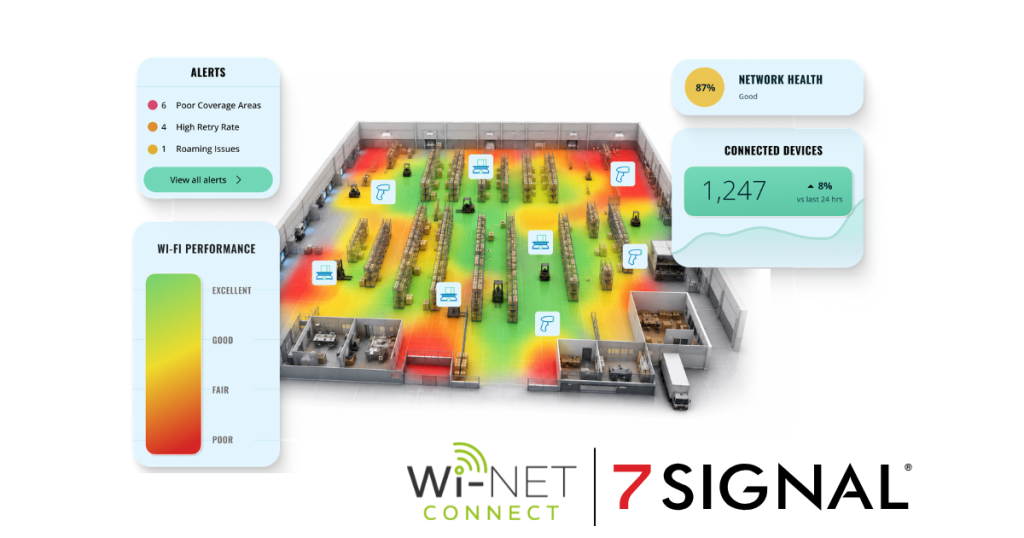
Continuous assurance monitoring measures the network from the client point of view, over time. Instead of a single pass or from the box outward, it watches the metrics that map to actual work getting done:
- Time to connect and time to roam, as devices actually experience them
- Coverage and signal quality tracked continuously, so seasonal drift shows as a trend rather than a surprise
- Interference and channel contention as they build, not after they have caused an outage
- Throughput and retry rates in the zones that matter, correlated with when problems appear
The difference is early warning. A one-off survey tells you the state on the day. Continuous monitoring tells you the direction of travel, which is the only thing that lets you act before the degradation reaches the shop floor.
The business case is measurable
This is not only an engineering argument. Continuous network monitoring shortens the two things that cost a warehouse most: the time to find a problem and the time the operation spends down because of it.
Organisations with continuous network monitoring in place identify problems up to 59% faster (IDC), and teams moving from reactive to proactive Wi-Fi assurance report up to 45% less unplanned downtime (7Signal).
In a distribution environment, downtime is not an abstract metric. It is idle pickers, stalled dispatch, and orders that miss the cut-off. Finding the fault faster and cutting the hours lost to it goes straight to throughput, which is why proactive monitoring pays for itself long before peak.
Assurance is the service that closes the gap
Wi-Net Connect’s Wi-Fi Assurance service exists precisely because the install-and-walk-away model leaves a gap that only continuous monitoring can close. It keeps eyes on your network from the client perspective, flags drift while it is still a trend rather than a fire, and gives your operation a network you can trust between surveys, not just on the day of one.
If your last real measurement of the Wi-Fi was its commissioning survey, the honest position is that you do not currently know how the network is performing. Assurance replaces that blind spot with a live picture. To see how your warehouse network is really performing today, book a Wi-Fi assurance assessment.