Posted: 24th March, 2026
Your warehouse has Wi-Fi. The office works perfectly. But somewhere out on the floor, down the racking aisles, near the loading dock, in the far corner, scanners lose connection, robots stop mid-route, and your team spends part of every shift waiting for devices to catch up.
If that sounds familiar, you’re not alone. It’s one of the most common problems we’re asked to fix. And the good news is that it’s not random, there’s a straightforward reason it happens, and a clear way to solve it.
First, Why Does Metal Racking Cause Problems?
Wi-Fi travels through the air as a radio signal, the same basic idea as a radio station broadcast, just at a much shorter range. And like any signal, it can be blocked, bounced around, or weakened by whatever’s in its path.
In most buildings, offices, shops, and schools, that’s not a big problem. Walls and ceilings affect the signal a bit, but Wi-Fi can generally find its way around.
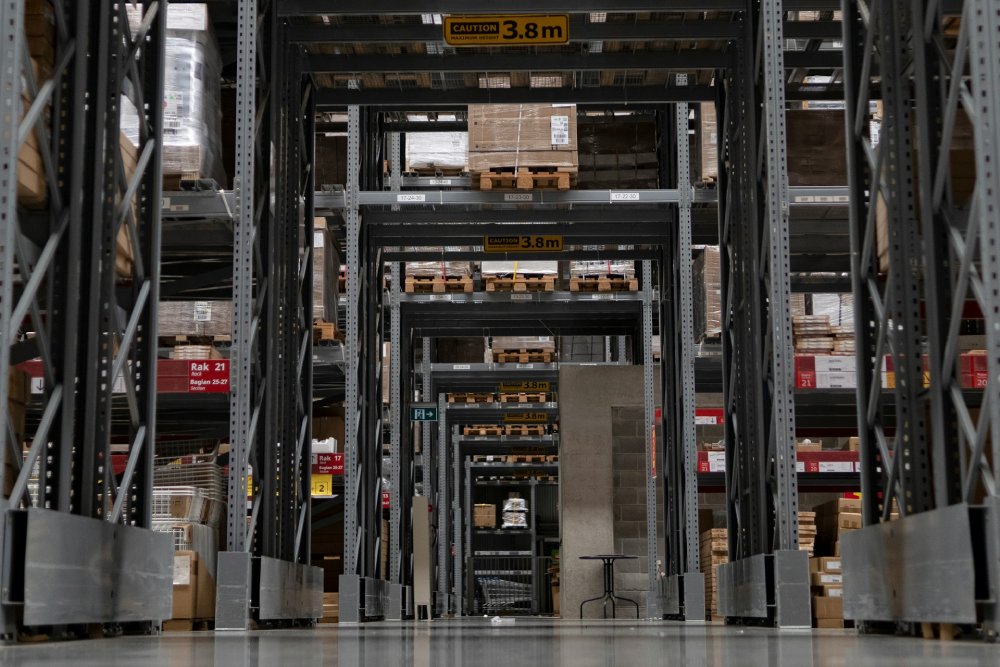
Warehouses are different. Steel racking is one of the worst possible materials for Wi-Fi to deal with. It blocks the signal, bounces it in unpredictable directions, and creates dead zones where the signal simply can’t reach.
THINK OF IT LIKE THIS…
Imagine trying to have a phone conversation while standing inside a large metal shipping container. You might get some signal, but it’ll be patchy and unreliable even though you’re not that far from a phone mast.The metal is getting in the way. That’s exactly what’s happening to your Wi-Fi in a racking aisle.
Add to that the fact that your stock levels change throughout the day; full pallets in the morning, half-empty bays by the afternoon and the problem gets more complicated. The signal that works at 7 am might not work the same way at 2 pm, because the physical environment has changed.
Standard Wi-Fi access points can’t adapt to that. They broadcast in the same pattern regardless of what’s in the way. If something’s blocking the signal, the signal doesn’t get through.
What Does This Actually Look Like Day to Day?
Here’s a quick way to work out if dead zones are affecting your operation. Do any of these sound familiar?
| What you’re seeing | What’s actually happening |
|---|---|
| Scanners keep dropping mid-pick | Metal racking is blocking the signal between the scanner and the nearest access point |
| AGVs or robots pausing unexpectedly | The robot has moved into an area that the Wi-Fi can’t reach reliably |
| Wi-Fi is fine in the office, but not on the floor | The network was designed for desk users, not a warehouse environment |
| Wi-Fi works fine in the morning but not by the afternoon | As stock levels change throughout the day, so does the signal and standard Wi-Fi can’t adapt |
| Dead zones near the loading dock | Coverage gaps at site edges where access points struggle to reach |
If you’re agreeing with more than one of these, dead zones are almost certainly part of what’s going on.
So Why Doesn’t More Wi-Fi Just Fix It?
The obvious answer when Wi-Fi isn’t reaching somewhere is to add another access point. Sometimes that does help. But in a warehouse, it can actually make things worse.
More access points broadcasting in the same space means more signal bouncing off the same racking, more interference between them, and a more confusing environment for your devices to navigate. Your scanner doesn’t just need a signal, it needs a clear, stable signal. More of a bad signal isn’t the solution.
How Smart Antennas Solve the Problem
Standard access points broadcast their signal in all directions at once, a bit like a lightbulb lighting up a whole room. That works fine in open spaces, but in a warehouse full of racking, a lot of that signal hits metal and goes nowhere useful.
RUCKUS access points work differently. Instead of broadcasting in every direction, they use smart antenna technology to constantly find the best path to each device. If the direct route is blocked by racking, the signal finds another way around. And it does this automatically, adjusting in real time as your environment changes throughout the shift.
The practical result is that you get reliable Wi-Fi coverage in the places that matter most, down the racking aisles, at the loading dock, across the picking floor without needing to fill the building with access points.
What Changes in Practice
| Without Smart Antennas | With RUCKUS Smart Antennas |
Standard Wi-Fi
Result: dead zones, dropped connections, pickers standing waiting |
RUCKUS with SmartAntenna
Result: reliable signal throughout the warehouse, all shift long |
How We Approach This
At Wi-Net Connect, we specialise in Wi-Fi for warehouses and logistics sites. Before we recommend anything, we visit your site, walk the floor, and understand how your operations actually work, we review the racking layout, what devices you’re using, and how your shifts work.
From there, we can identify exactly where the signal is struggling and why. We’ll show you what’s causing the problem and what it would take to fix it clearly, without technical jargon, and before you commit to anything.
We work with RUCKUS Networks because their smart antenna technology is genuinely the best solution we’ve found for warehouse environments. We’ve deployed it across a range of logistics, fulfilment, and manufacturing sites, and the results speak for themselves.
If you’re already running RUCKUS hardware but still having issues, we can often help with that too. Sometimes the problem is how the existing system is configured rather than the equipment itself.
Think your warehouse might have dead zones?
We offer a coverage assessment where we come to your site, map out where the signal is struggling, and tell you exactly what’s causing it and what it would take to fix it. No jargon, no obligation.
Request your assessment: 02036 970246 | info@wi-netconnect.co.uk